
Silk-Screen Printing
IN DEPTHAlso: screen printing, silkscreen, screen print
A decoration method that pushes ink through a mesh screen, one screen per solid color, to print flat, durable logos on drinkware.
How it works
Silk-screen printing pushes ink through a fine mesh screen directly onto the bottle or tumbler. Each solid color in the design gets its own screen, and the colors are applied one after another with careful registration between passes. Because setup is per color rather than per piece, one-to-three-color logos run fast and are inexpensive in production volume.
Where it performs best
This is the economical default for solid-color logos, word marks, and simple line art. It bonds especially well to powder-coated surfaces, where cured ink holds up through shipping, retail handling, and daily use. The method’s limit is tonal range: it prints flat, solid areas, so photographic gradients and soft blends are out of scope. For those, see heat-transfer printing.
For a single Pantone color or a simple two-color lockup, screen printing is hard to beat on cost per unit. Setup charges are modest and amortize quickly across a run, while the print stays crisp even at small logo sizes. Pushing past roughly three colors adds screens and registration steps, at which point many buyers move to heat transfer for busier artwork.
| Factor | Silk-screen printing |
|---|---|
| Best for | 1–3 solid colors, logos, text |
| Photographic gradients | Not suitable |
| Durability on powder coat | Very high |
| Setup cost | Low, charged per color |
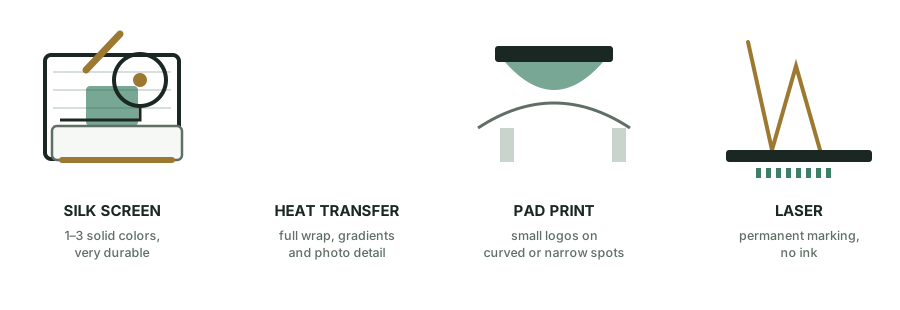
The diagram above shows screen printing alongside the other common decoration methods, so you can compare coverage and typical use cases at a glance. Flat, solid areas are also easy to inspect, so color or coverage defects are quick to spot on the line.
Practical takeaway: Choose silk-screen printing for logos of three solid colors or fewer to keep unit cost low without sacrificing durability on coated surfaces.