
LFGB, FDA and EU Food-Contact Rules: How Buyers Define Test Scope

Direct answer: Drinkware food contact compliance is not established by requesting a generic “LFGB” or “FDA certificate.” Buyers must define the destination market, exact SKU, every food-contact component, material composition, intended foods, repeated-use conditions, time and temperature. Then the responsible compliance team or laboratory can map applicable EU, German or U.S. requirements and issue evidence limited to the identified scope.
A stainless-steel tumbler is a multi-material article. Its beverage-contact path may include steel, plastic, silicone, coatings, ink, adhesive, straw parts and a gasket. Testing only the body cannot automatically establish the status of the lid. Testing one lid resin cannot automatically cover another colorant, supplier or design.
The correct question is therefore not “Is the factory LFGB/FDA certified?” It is “What evidence supports this product configuration for its intended market and conditions of use?”
Verification date: Regulatory references and links in this article were reviewed on October 7, 2026. Buyers should confirm the current consolidated rules and amendments before commissioning testing or approving a shipment.
Understand What the Labels Mean
| Term | What it refers to | What buyers should not infer |
|---|---|---|
| EU food-contact rules | A framework and material-specific legal requirements for articles placed on the EU market | One universal test list for every material and use |
| Regulation (EC) No 1935/2004 | EU framework principles for food-contact materials | A catalog-wide product certificate |
| Regulation (EU) No 10/2011 | EU rules for plastic materials and articles, including composition, restrictions and migration provisions | Automatic coverage of steel, silicone, coatings and every non-plastic component |
| LFGB | Germany's Food and Feed Code, operating alongside applicable EU and German provisions | A single global certification mark or automatic approval of all products |
| FDA food-contact status | U.S. regulatory status of substances for intended food-contact use under applicable authorizations and conditions | A generic “FDA-approved factory” or automatic article-wide certificate |
The European Commission states that all food-contact materials placed on the EU market must comply with Regulation (EC) No 1935/2004 and be manufactured under GMP requirements in Regulation (EC) No 2023/2006. It also notes that specific EU measures apply to certain materials, including plastics (European Commission, Food Contact Materials).
For plastics, the Commission explains that Regulation (EU) No 10/2011 controls composition, permitted substances, restrictions, migration testing and declarations of compliance. The regulation is regularly amended, so the applicable consolidated text and amendment history need to be checked for the project (European Commission, Legislation).
Germany's LFGB is national legislation, including provisions concerning consumer products and transfer of substances to food. It should be read with directly applicable EU law and any relevant German measures or official methods—not treated as a standalone product badge (German Federal Ministry of Justice, LFGB).
In the United States, FDA states that the overall regulatory status of a food-contact material depends on each substance composing the article and its intended use. Applicable bases may include regulations in 21 CFR, an effective Food Contact Substance Notification, prior sanction, GRAS status or a Threshold of Regulation exemption. Conditions and limitations matter (FDA, Determining Regulatory Status).

Build the Scope From the Product, Not the Acronym
Start with a product-contact map. Identify each component that touches the beverage or may reasonably transfer substances under foreseeable use.
For a typical drinkware SKU, review:
- interior stainless-steel body;
- any internal coating or lining;
- plastic lid base;
- spout, slider or plug;
- straw and straw connector;
- silicone gasket or valve;
- adhesive or bonding layer where relevant;
- printed or coated areas near contact surfaces;
- accessories intended to contact food or drink.
Then record the material identity for each component. “Plastic” is insufficient. The compliance review may need polymer type, grade, additive/colorant information, supplier declaration and applicable authorization. “Silicone” or “stainless steel” likewise does not define every composition or use condition.
Define Intended Use Conditions
Food-contact assessment is use-specific. Provide the laboratory or compliance specialist with:
- Food or beverage types: water, acidic beverages, fatty foods where relevant, coffee, tea or other intended contents.
- Temperature: cold fill, hot fill, boiling liquid, reheating or another defined range.
- Contact duration: short service, hours of storage or repeated long-term contact.
- Repeated use: expected cleaning and reuse pattern.
- Contact geometry: fill volume, surface area and which parts contact contents.
- Special users or claims: children, infant use or other categories only when actually intended.
- Destination: EU generally, Germany specifically, the United States or another market.
- Buyer protocol: retailer or brand requirements that go beyond the legal baseline.
For EU plastic migration testing, the Commission explains that food simulants and standardized time/temperature conditions represent categories of use. Scope must therefore reflect foreseeable worst-case conditions rather than an arbitrary test package.
Create a Component-to-Evidence Matrix
| Component | Material/specification | Intended contact | Market basis to evaluate | Evidence status |
|---|---|---|---|---|
| Inner vessel | Exact steel grade/finish | Beverage, stated temperature and duration | EU/German or U.S. basis as applicable | Existing, gap or test needed |
| Lid | Identified polymer and additives | Direct or repeated splash contact | EU plastics rules or U.S. authorization basis | Existing, gap or test needed |
| Gasket | Identified elastomer/silicone formulation | Direct contact | Applicable national/EU or U.S. basis | Existing, gap or test needed |
| Straw/spout | Exact resin and color | Direct beverage flow | Applicable plastics/authorization scope | Existing, gap or test needed |
| Coating/ink/adhesive | Exact system and location | Direct, indirect or no intended contact | Applicable requirements based on exposure | Existing, gap or test needed |
This table should reference supplier declarations, report numbers, model numbers and dates. It also helps a laboratory avoid testing irrelevant components while missing a small but critical food-contact part.
Decide Whether Existing Evidence Is Representative
An existing report may be useful if it matches the current order. Compare:
- legal applicant and manufacturer where identified;
- sample name, model and photographs;
- bill of materials and component suppliers;
- resin, colorant, coating and gasket formulation;
- test requirement and edition;
- food simulants or substance scope;
- time, temperature and repeated-use cycles;
- test report date;
- conclusion and any limitations;
- changes since the sample was submitted.
Do not rely on the report merely because it says “LFGB,” “FDA,” or carries a known laboratory name. A result for one stainless-steel bottle, one plastic resin or one color does not automatically cover a different assembled SKU.
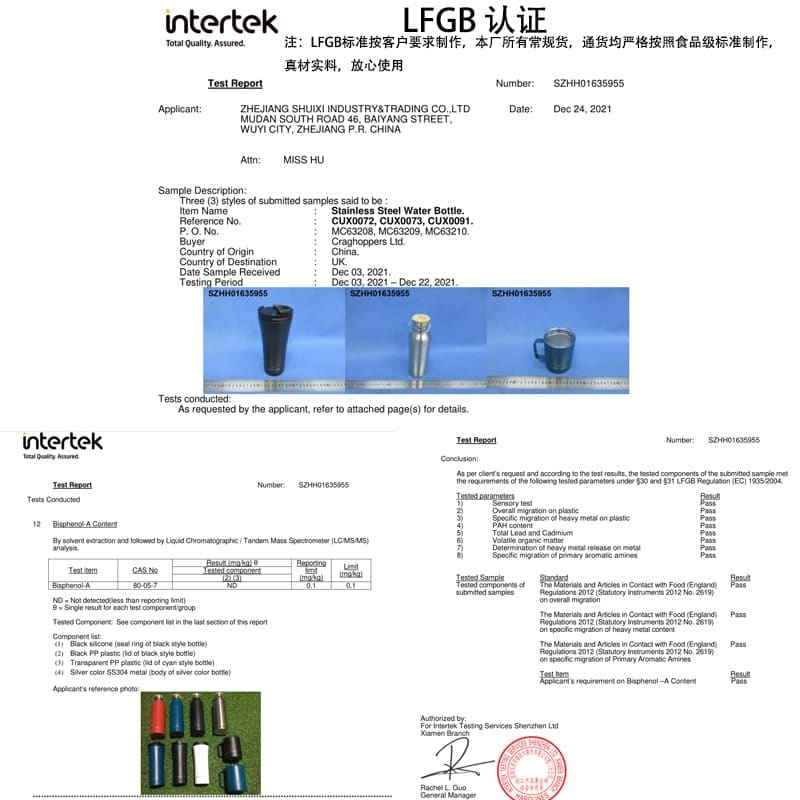
Watersy's archive includes a 2021 LFGB-related test report for a specific stainless-steel bottle. It can be reviewed only for the sample, model, methods, conditions and date stated in that report. It is not proof that Watersy's complete product catalog currently holds LFGB certification. Watersy's internal baseline also does not support a current catalog-wide FDA certification claim.
Distinguish Testing From Regulatory Documentation
Testing may be one part of the evidence package, but compliance is not always reduced to a laboratory pass/fail page.
For EU plastic food-contact materials, a Declaration of Compliance is supported by underlying documentation; the Commission describes the DoC as communicating composition and compliance information through the supply chain. Other materials may be subject to different EU or national documentation requirements.
For U.S. projects, evidence should identify the regulatory basis for each relevant substance and its conditions of use. FDA specifically notes that an effective Food Contact Substance Notification can be proprietary to the identified manufacturer and substance; a similar material from another source cannot automatically rely on it.
A buyer's file may therefore include:
- final bill of materials;
- supplier declarations and traceability;
- relevant authorization or regulatory citations;
- test reports for identified samples;
- EU Declaration of Compliance where legally applicable;
- GMP and change-control records;
- approved specification and production sample;
- documented rationale linking evidence to the SKU.
Set Change Triggers
Reassess scope when any of the following changes:
- polymer, steel, silicone, coating, ink or adhesive;
- material supplier or formulation;
- colorant or masterbatch;
- food-contact geometry or surface area;
- lid, straw, gasket or accessory;
- intended beverage, temperature, duration or repeated use;
- manufacturing site where relevant to the evidence;
- model or product family represented;
- destination market or buyer protocol;
- applicable law, restriction or test method.
The response may be a documentation update, technical assessment or new testing. It should be decided by the responsible compliance specialist or laboratory against the defined change, not by a blanket marketing statement.
Watersy's Manufacturer View
Watersy manufactures stainless-steel drinkware and supports PP, Tritan and silicone lid-related components, with product configuration and documentation reviewed by project. The factory can discuss FDA-related documentation/testing, LFGB-related evidence, BPA-Free, RoHS or other requests according to construction, target market and RFQ; these are not universal company certifications.
From a manufacturing perspective, the best test request arrives after the SKU, bill of materials, color/component set and intended use are stable. Testing too early risks assessing a sample that later changes. Testing too broadly without a component map can waste time while still leaving evidence gaps.
Use the certificate and test-report verification guide to authenticate reports and the Drinkware Compliance Guides for related supplier-document controls.
Food-Contact Scope Checklist
Before requesting a quote from a laboratory or documents from a supplier, provide:
- destination country or region;
- exact product and model number;
- complete food-contact component list;
- material grades, formulations and suppliers where required;
- colors and coatings;
- intended beverages or foods;
- maximum contact temperature and duration;
- repeated-use and cleaning assumptions;
- product photographs and drawings;
- current bill of materials;
- buyer-specific protocols;
- existing reports and declarations;
- known changes since earlier testing;
- required document language and order milestone.
The result should be a written scope tied to the product—not a request for the broadest-sounding acronym.
Request Project-Specific Compliance Documents
Send Watersy the exact SKU, food-contact components, materials, intended use, target market and buyer protocol. We can identify available evidence, disclose its model and date limitations, and coordinate discussion of additional documentation or testing needed for that defined product.
Request Project-Specific Compliance Documents
Sources and further reading
Related guides