
How to Verify a Drinkware Certificate or Test Report Before You Buy

Direct answer: To verify a drinkware certificate or test report, first identify what the document actually is. Then match its legal entity, site, scope, product sample, materials, test methods, dates and issuer to your intended order. Confirm management-system certificates with the certification body or an accredited-certification database, and confirm laboratory reports directly with the issuing laboratory when necessary.
A PDF with a logo is not enough evidence that the drinkware you plan to buy is compliant. The document may cover a management system rather than a product, an audit rather than a certification, or one old sample rather than the current SKU. A useful review therefore asks two questions separately:
- Is the document authentic and current?
- Does it apply to the exact product, material, factory, market and use condition in this purchase?
This guide gives sourcing, quality and compliance teams a repeatable way to answer both questions before approving a supplier or purchase order.
Start by Classifying the Document
Misclassification is one of the fastest ways to reach the wrong buying decision. A management-system certificate, social responsibility audit and product-specific test report serve different purposes.
| Document type | What it can indicate | What it does not prove |
|---|---|---|
| Management-system certificate, such as ISO 9001, ISO 14001 or ISO 45001 | A named organization and defined scope have been assessed against a management-system standard | That every bottle, tumbler, coating, lid or component passed a product safety test |
| Social responsibility audit, such as amfori BSCI or a SMETA audit | A site was assessed at a particular time under a social-audit methodology | Product conformity, permanent compliance, or a general “certified factory” status |
| Product-specific laboratory report, such as a migration, composition or EMC report | The submitted sample was tested against identified methods or requirements | Automatic coverage of every SKU, material, color, component, factory or future production lot |
| Supplier declaration or declaration of compliance | A responsible party declares conformity for a defined product and legal framework | Independent laboratory verification unless supporting evidence is also supplied |
ISO explains that ISO itself develops standards but does not certify companies; external certification bodies issue certificates. ISO also distinguishes certification from accreditation, which is independent recognition of a certification body's competence (ISO, Certification). amfori states that amfori BSCI audits are not certifications, and Sedex says neither SMETA nor Sedex membership is a certification (amfori, Audits; Sedex, What We Do).
That distinction should control the wording in your supplier scorecard. Record “management-system certificate,” “social audit report,” or “product test report”—not the vague label “certificate.”

Use a Nine-Step Verification Workflow
1. Obtain the complete, legible document
Do not approve a cropped cover, badge, website icon or low-resolution screenshot. Request all pages, including annexes, sample photographs, test results, conclusions, signatures, accreditation marks and any scope schedule. For a report, check that page numbering is continuous and that the report number is consistent throughout.
Ask the supplier to send the file through a controlled procurement channel. Save the original file and record the date received; do not rely on a sales presentation as the evidence archive.
2. Match the legal entity and manufacturing site
Compare the certificate holder or report applicant with the legal entity on the quotation, business license, purchase order and invoice. Then check the physical address.
A valid document issued to a trading company, related company or different factory may still be useful background, but it does not automatically cover the production site for your order. If names differ because of a translated name, group structure or address update, request documentary linkage instead of assuming the entities are the same.
3. Read the scope word by word
For a management-system certificate, record:
- standard and edition;
- certified legal entity;
- site address or sites;
- certified activities and product scope;
- certificate number;
- issue, effective and expiry dates;
- certification body and accreditation information.
The scope may be narrower than the supplier's entire business. “Manufacture of stainless-steel vacuum ware,” for example, should not be stretched to unrelated plastics, glassware or another site without evidence.
For a test report, the equivalent scope is the sample description, materials, model numbers, photos, test items, methods and conclusion.
4. Match the tested sample to your purchase specification
Create a line-by-line bridge from the report to the product you intend to order:
| Purchase detail | Evidence to match in the report |
|---|---|
| Body material and grade | Sample description, bill of materials or supporting declaration |
| Lid, straw, gasket and internal coating | Component names and food-contact status |
| Color and surface finish | Sample photo or description; pigment/coating changes may matter |
| Capacity and model | Model number, dimensions or representative-family rationale |
| Intended contents | Food type or simulant used in testing |
| Time and temperature | Test conditions that cover foreseeable use |
| Target market | Cited regulation, standard or customer protocol |
A report for one stainless-steel bottle should not be presented as proof for every tumbler, coffee mug, ice bucket or lid system. Likewise, changing a resin, colorant, coating, adhesive, supplier or construction can affect whether old evidence remains representative.
5. Check the requirement, method and result
Look beyond a “PASS” stamp. Confirm what was tested, which edition or legal requirement was used, the detection limits where relevant, and whether every requested item has a result.
For EU food-contact projects, the European Commission states that food-contact materials placed on the EU market must comply with Regulation (EC) No 1935/2004. It also explains that declarations of compliance for relevant materials rely on supporting documentation (European Commission, Food Contact Materials; Legislation). In the United States, FDA notes that the status of a food-contact material depends on the regulatory status of each substance that makes up the article and its conditions of use (FDA, Determining Regulatory Status).
This is why “FDA approved bottle” is usually too imprecise for a buyer's evidence file. Ask which material, regulatory basis and intended use the claim refers to.
6. Check dates in context
A management-system certificate normally displays an issue or effective date and an expiry date. Confirm that it is current and has not been suspended or withdrawn.
A laboratory report does not necessarily become false on a simple anniversary, but age still matters. Ask whether the product design, materials, suppliers, manufacturing site, test method or law has changed since the sample was tested. A technically authentic old report may no longer be representative of today's order.
A social audit is a time-bound snapshot. Record the audit date, monitoring period or validity stated by the scheme, findings and corrective-action status. Never convert an expired audit report into a current “certification.”
7. Authenticate the issuer
For accredited management-system certification, ISO recommends using IAF CertSearch or contacting the relevant certification or accreditation body directly (ISO, Certification). Search by the exact legal name and certificate number, then compare status, standard, scope and sites.
For laboratory reports:
- visit the laboratory's official website rather than a link embedded in an editable sales file;
- use its report-verification service if available;
- otherwise contact the laboratory using independently obtained contact details;
- provide the report number and ask whether the file is authentic and unchanged;
- check whether the relevant test sits within the laboratory's accredited scope when accreditation is a buyer requirement.
A famous laboratory name on the first page is not enough if the report number, applicant, sample or pages cannot be verified.
8. Resolve gaps before purchase-order approval
Turn each mismatch into a closed action. Examples include requesting an updated certificate, testing a revised lid, adding a missing component, obtaining a current audit, clarifying the manufacturing address, or commissioning a market-specific test on a production-representative sample.
The right response is not always “reject the supplier.” It may be “do not rely on this document for this claim until the gap is closed.”
9. Freeze the approved evidence to the order
Link the approved document set to the final specification, bill of materials, golden sample and purchase order. Define change-notification rules for materials, sub-suppliers, tooling, coatings and manufacturing location. If a relevant change occurs, reassess whether new testing or documentation is required.
This final step prevents a common failure: verifying one sample and then buying a materially different production configuration.
A Fast Buyer Red-Flag Checklist
Pause approval when you see any of the following:
- a logo or badge with no complete document;
- a certificate holder that does not match the contracting or manufacturing entity;
- an expired, suspended or unverifiable certificate;
- a report with missing pages or inconsistent report numbers;
- a sample photo or model that does not match the quoted product;
- no test coverage for the lid, gasket, straw, coating or other food-contact component;
- a broad claim such as “all products certified” based on one sample;
- an amfori BSCI or SMETA audit described as product certification;
- “FDA approved” with no material-level regulatory basis and conditions of use;
- altered dates, blurred signatures or unverifiable QR codes;
- a report from another company or factory without a documented relationship;
- pressure to accept a marketing slide instead of primary evidence.
What Watersy's Current Documents Can—and Cannot—Support
Watersy's internal evidence review, verified on October 7, 2026, separates the available records into four groups:
- Current management-system certificates: ISO 9001:2015, ISO 14001:2015 and ISO 45001:2018. The reviewed certificates were issued on September 21, 2026 and expire on September 20, 2029.
- Historical social-audit evidence: the available 2024 amfori BSCI report expired on December 27, 2025. It must not be described as a current certification.
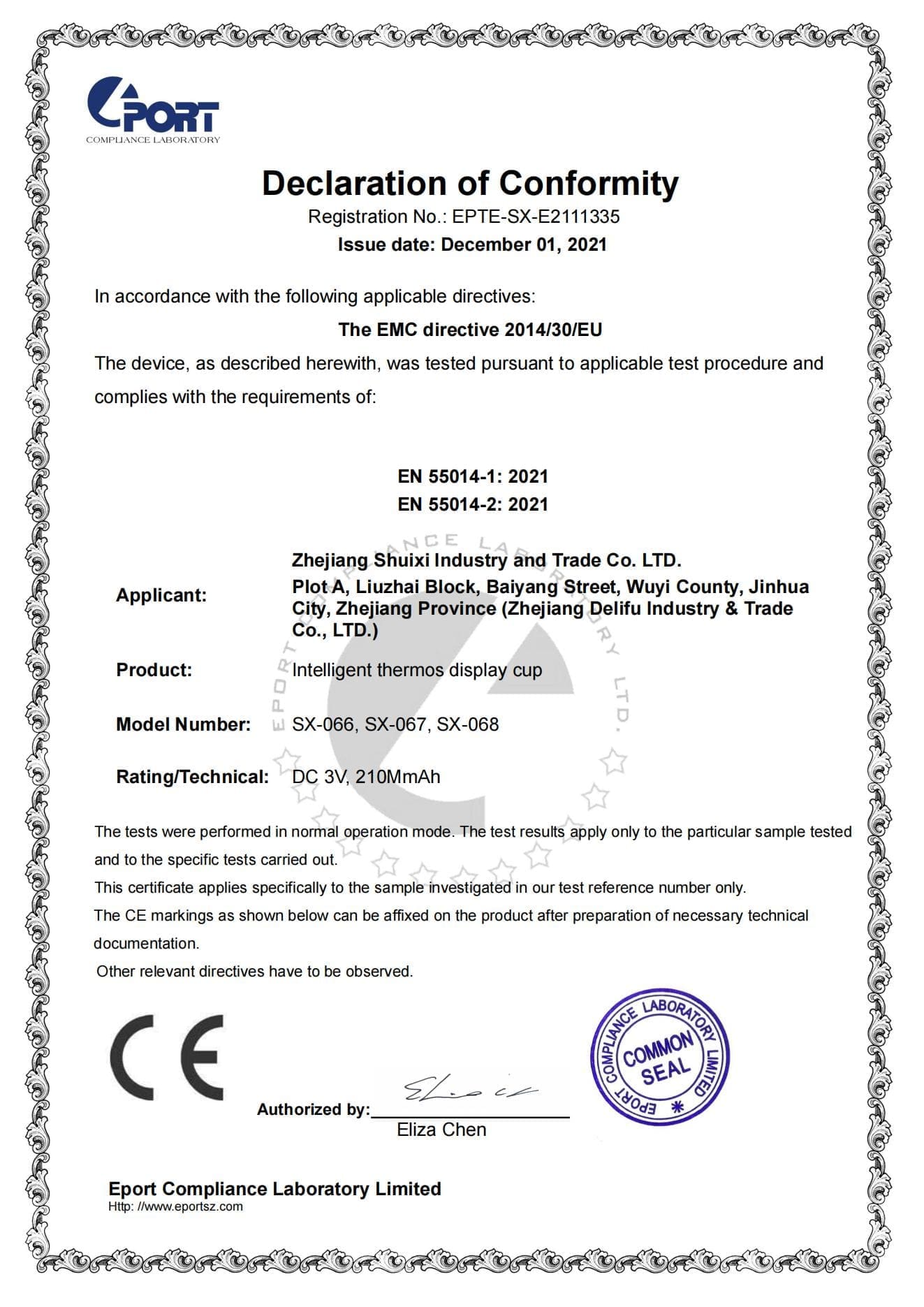
- Product-specific or historical reports: the available LFGB evidence relates to a specific stainless-steel bottle tested in 2021; CE/EMC evidence relates to a specific smart temperature-display cup; available SGS material relates to a specific 2019 product and is not a complete report package in the current project archive.
- Documents not sufficiently verified in the current project archive: SEDEX, FDA, BPA-Free, RCS, RoHS and GS/QS.
These boundaries matter. Watersy should not claim that every product is certified or that one report covers the complete catalog. For a live inquiry, the correct process is to identify the SKU, components, target market and intended use, then provide or arrange the relevant evidence for that project.
Build a Defensible Approval Record
A good compliance file should allow a colleague—or a customer—to reconstruct why the product was approved. Record the document type, issuer, number, holder, site, scope, sample, methods, dates, verification route, gaps, corrective actions and final decision.
The most important principle is simple: verify applicability, not just appearance. Authentic paperwork can still be irrelevant to your order, while a responsible supplier should be willing to define exactly what its documents cover.
Request Project-Specific Compliance Documents
Preparing a drinkware program for the United States, Europe or another market? Send Watersy the target SKU, materials, intended use, destination market and buyer protocol. Our team can review which current management-system certificates and product-specific documents are relevant, identify evidence gaps, and discuss any additional testing required before order approval.
Sources and further reading
Related guides