
Management Systems, Social Audits and Product Tests: Know the Difference

Direct answer: A management-system certificate evaluates a named organization's system within a stated scope. A social audit evaluates workplace practices at an identified site and time. A product test report records results for submitted samples, methods and conditions. None automatically substitutes for another, and every document must be matched to the correct legal entity, site, product, scope and date.
The phrase “factory certificate” hides several different types of evidence. A buyer may receive an ISO certificate, an amfori BSCI report, a SMETA report, an LFGB-related laboratory report or a testing-company document and place them in one folder. That is convenient administratively but dangerous analytically: each document answers a different procurement question.
The first step in verification is classification. Only then can a buyer decide whether the evidence is authentic, current and applicable to the proposed drinkware order.
Compare the Three Evidence Types
| Evidence type | Object assessed | Typical output | Appropriate buyer use | Does not establish |
|---|---|---|---|---|
| Management-system certification | Named organization's system and certified scope | Certificate with standard, holder, scope, issuer and dates | Supplier-level review of management controls | Product safety or conformity for every SKU |
| Social audit | Identified worksite at a stated audit time | Audit report, findings and corrective actions | Responsible-sourcing due diligence | Product conformity, permanent compliance or ISO quality certification |
| Product-specific test | Submitted sample under identified methods and conditions | Laboratory report with sample, tests and results | Evidence for defined product/material requirements | Coverage of untested models, components, colors or future production |
ISO defines certification as independent written assurance that a product, service or system meets specified requirements. ISO itself does not perform certification or issue certificates; external certification bodies do (ISO, Certification). The certificate therefore needs to be read for its holder, sites, scope, standard edition, issuer and dates.
Sedex describes SMETA as a social audit and states that neither SMETA nor Sedex membership is certification; its methodology does not issue a “pass” or “fail” (Sedex, What We Do). amfori BSCI materials should likewise be handled as social-audit evidence, not a product or quality-management certificate.
What a Management-System Certificate Tells You
ISO 9001, ISO 14001 and ISO 45001 are management-system standards addressing quality, environmental management, and occupational health and safety respectively. A current certificate can support confidence that a named organization operates an assessed management system within its defined scope.
A buyer should record:
- exact legal holder;
- manufacturing address or covered sites;
- standard and edition;
- certified activity and product scope;
- certificate number;
- certification body and accreditation information;
- issue/effective and expiry dates;
- current, suspended or withdrawn status.
A certificate does not prove that a particular bottle, lid, coating or gasket meets food-contact requirements. It does not prove zero defects, a performance duration, recycled content, ethical-trade compliance or on-time delivery.
Use ISO evidence to ask better process questions: How are specifications controlled? How are material and tooling changes approved? How are inspections and nonconformities recorded? Then seek product-level evidence for the exact SKU.
What a Social Audit Tells You
A social audit examines workplace conditions and practices against a methodology or buyer program at a particular site and time. The buyer should review the full report, audit date, site, scope, findings, follow-up, corrective-action status and any methodology-specific timing rules.
A social audit is a snapshot within a broader due-diligence program. It should not be converted into statements such as:
- “BSCI-certified quality system”;
- “SMETA-certified product”;
- “permanently compliant factory”;
- “passed forever”;
- “no further buyer due diligence required.”
Watersy's project archive contains a 2024 amfori BSCI social-audit report whose recorded validity ended on December 27, 2025. As of this article's verification date, October 7, 2026, it is historical evidence only and must not be presented as current certification. A buyer needing current social-audit evidence should state its required program, site, timing and corrective-action expectations in the RFQ.
What a Product Test Report Tells You
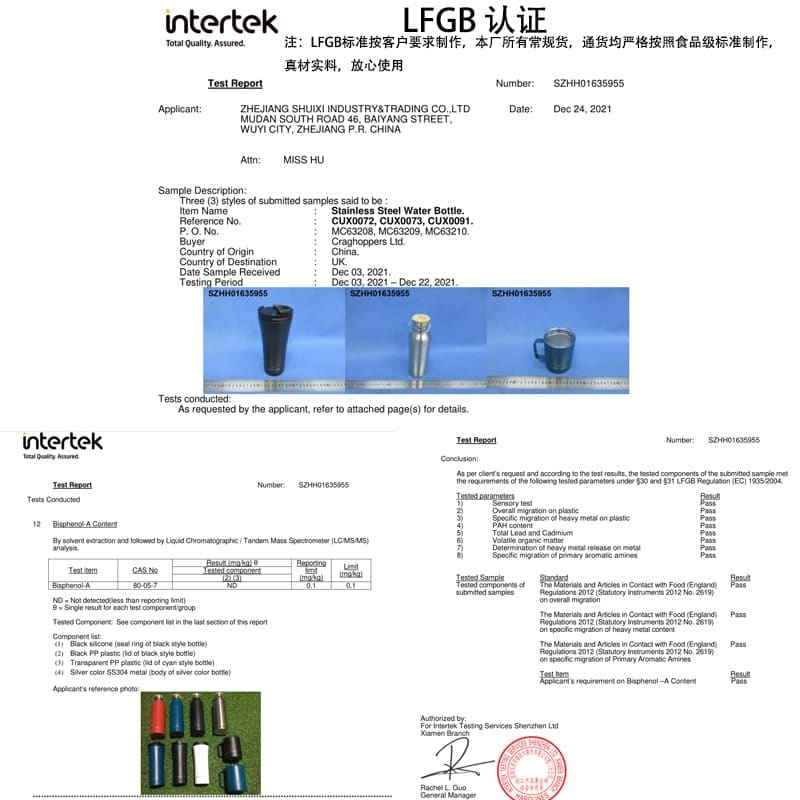
A laboratory report should identify the applicant, manufacturer where stated, sample, model, photographs or description, materials or components, test items, methods, conditions, results, report number and dates. It supports only the conclusions justified by those fields.
For drinkware, scope questions include:
- Was the body, lid, gasket, straw, coating or printed area included?
- Does the model number match the quoted SKU?
- Are material and color variants represented?
- Which regulatory requirement or buyer protocol was used?
- Which food simulant, time and temperature were applied where relevant?
- Is the report complete and authentic?
- Have product, material, supplier, site or rules changed since testing?
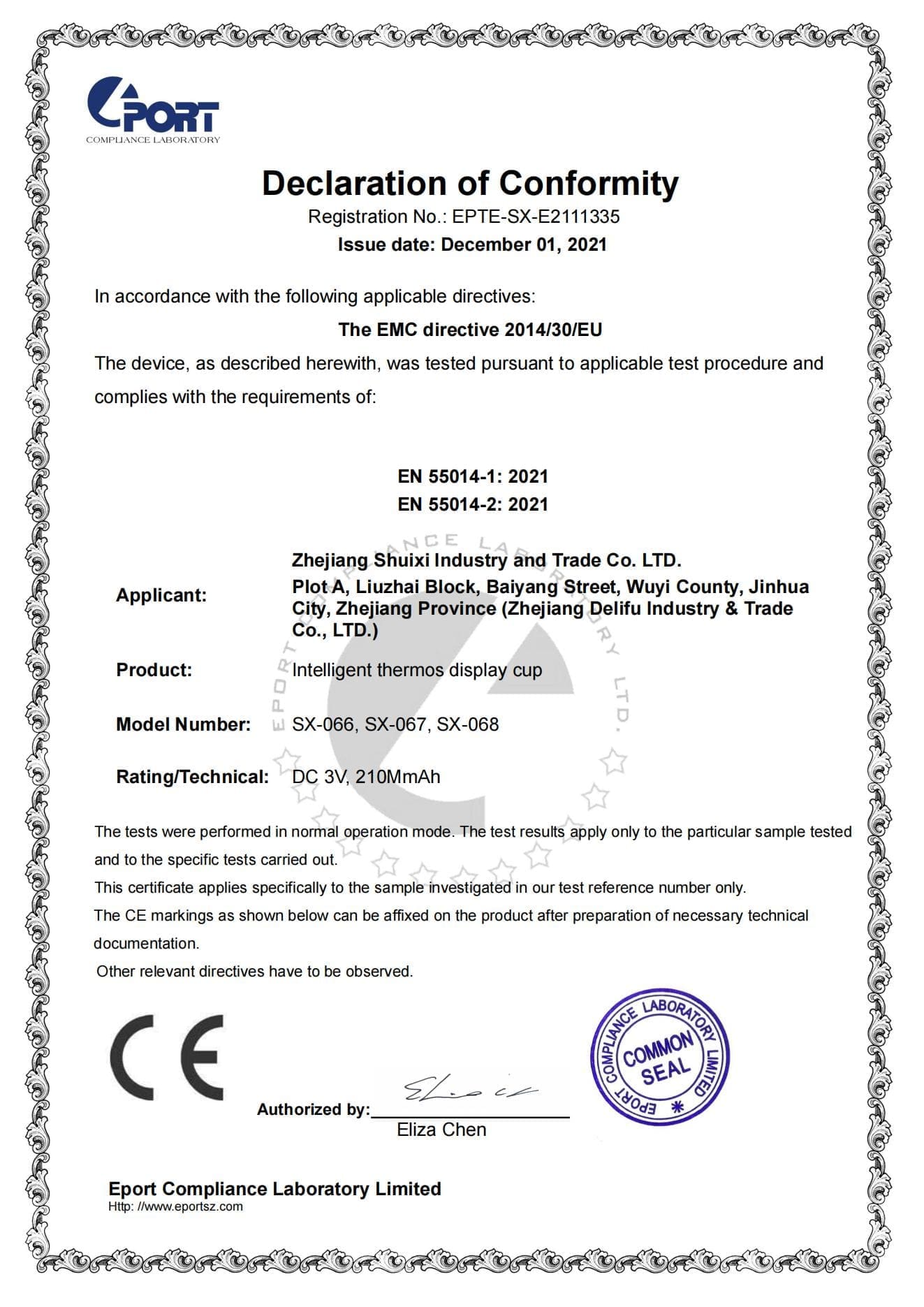
A report bearing an SGS or another laboratory name is still a product-specific report, not a catalog-wide “SGS certification.” Likewise, an LFGB-related report for one sample does not certify every product made by the factory. CE marking or EMC evidence, where applicable to a particular electronic feature, cannot be generalized to ordinary non-electrical drinkware.
Match the Document to the Buying Question
| Buying question | Primary evidence to request |
|---|---|
| Does the supplier operate a quality-management system? | Current ISO 9001 certificate plus process evidence |
| How does the site manage environmental aspects? | Current ISO 14001 certificate plus site controls |
| How does the site manage occupational safety? | Current ISO 45001 certificate plus site evidence |
| What did a social audit find at this worksite? | Full current site-specific audit and corrective-action record |
| Does this plastic lid meet an identified food-contact requirement? | Material documentation and/or test evidence scoped to that lid and intended use |
| Did this assembled SKU pass a specified test? | Complete report matching model, sample, method and conditions |
| Does every item in the catalog comply? | No single generic document; build evidence by product family, construction and market |
The document name should follow the buying question. Calling everything a certificate encourages unsupported conclusions.
Use a Four-Layer Verification Method
1. Identity
Match the legal entity, factory site, report applicant and contracting party. If names differ, request documentary linkage.
2. Scope
For systems, read the certified activities and sites. For audits, identify the worksite and methodology. For tests, identify sample, model, component, material, methods and conditions.
3. Status and date
Confirm that certificates are current and active. Treat audits as time-bound. For test reports, consider report date together with changes to the product, suppliers, methods and law; age alone is not the only question.
4. Order linkage
Tie approved evidence to the purchase specification, bill of materials, sample and change-control record. If a material, colorant, coating, component or manufacturing location changes, reassess applicability.
For a full workflow, use Watersy's certificate and test-report verification guide and Drinkware Compliance Guides.
Watersy's Evidence Boundaries
Watersy's reviewed company evidence, verified on October 7, 2026, includes current management-system certificates issued to Zhejiang Shuixi Industry & Trading Co., Ltd.:
| Standard | Certificate number | Issue date | Expiry date | Correct interpretation |
|---|---|---|---|---|
| ISO 9001:2015 | 20226Q01116R001 | 2026-09-21 | 2029-09-20 | Quality-management system within the certificate's stated entity, site and scope |
| ISO 14001:2015 | 20226E00522R001 | 2026-09-21 | 2029-09-20 | Environmental-management system within the stated scope |
| ISO 45001:2018 | 20226S00487R001 | 2026-09-21 | 2029-09-20 | OH&S management system within the stated scope |
Separate historical or product-specific materials include the expired 2024 BSCI audit, a 2021 LFGB-related report for a specific stainless-steel bottle, CE/EMC evidence for a specific smart temperature-display cup, and 2019 SGS material for a specific product. None supports a claim that every Watersy product is “LFGB/FDA/CE/SGS certified.”
SEDEX/SMETA, FDA-related documentation or testing, BPA-Free, RCS, RoHS and SGS testing can be discussed according to product construction, target market and RFQ. They are not represented here as universal, current company certifications.
Buyer Red Flags
Pause approval if you see:
- a logo without the underlying document;
- a management certificate used as product evidence;
- an audit called a product certification;
- an expired audit described as current;
- a report for a different model or company;
- missing sample photos, methods, pages or dates;
- a “PASS” claim without the requirement and conditions;
- an entire catalog covered by one bottle report;
- “FDA approved” without material, authorization and conditions of use;
- “SGS certified” without identifying the tested sample and report;
- unrecorded changes after the evidence was approved.
Request Compliance Documents
Send Watersy the legal entity you will contract with, target SKU, materials, intended use, destination market and buyer protocol. We can provide the relevant current management-system documents, disclose the limits of available historical or product-specific evidence, and discuss additional documentation or testing for the defined order.
Sources and further reading
Related guides