Incoterms: EXW, FOB, CIF, DDP
IN DEPTHAlso: International Commercial Terms, Incoterms 2020
Incoterms are ICC rules that define where cost and risk transfer between buyer and seller in international trade.
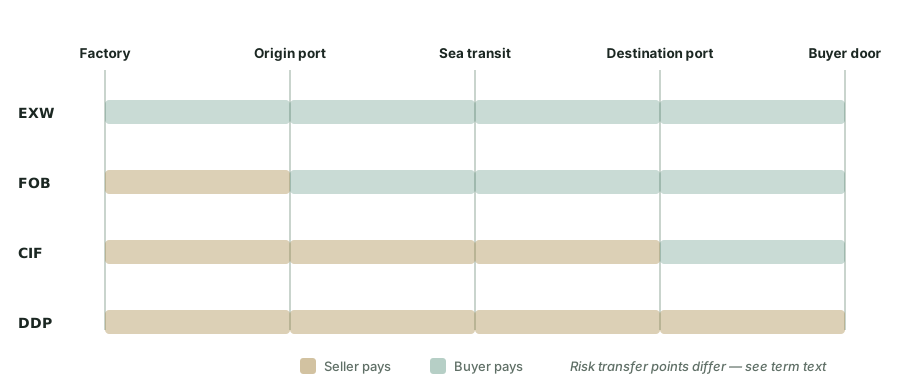
Incoterms (International Commercial Terms) are a set of ICC rules, most recently Incoterms 2020, that spell out who arranges and pays for each stage of transport and where risk passes from seller to buyer. They do not cover payment, ownership of goods, or the sales contract itself — only delivery responsibilities. The diagram above shows how each term shifts responsibility between the two parties.
The four terms buyers most often see
EXW (Ex Works) is the most buyer-loaded: you take over at the factory gate and arrange and pay for everything after. FOB (Free On Board) means the seller delivers cleared goods onto the vessel at the origin port, after which risk and cost shift to you. CIF (Cost, Insurance and Freight) adds the seller paying freight and insurance to the destination port, but risk still transfers to you at loading. DDP (Delivered Duty Paid) is the most seller-loaded: the seller delivers to your door with import duties paid.
| Term | Who arranges main carriage | Where risk passes | Who pays import duty |
|---|---|---|---|
| EXW | Buyer | Factory gate | Buyer |
| FOB | Buyer | On board vessel | Buyer |
| CIF | Seller | On board vessel | Buyer |
| DDP | Seller | Buyer’s door | Seller |
Choosing the right term
New importers often prefer DDP for a predictable landed cost, while experienced buyers with their own forwarder frequently take FOB and control the freight leg themselves. Whatever you choose, the term should be written into the proforma invoice and matched with the insurance you actually need. Ask your freight forwarder to quote the full landed cost under each term before you choose.
Practical takeaway: Pick the term that matches how much of the shipping and customs process you want to control, and confirm it in writing on every proforma invoice.