
BPA-Free, PFAS and Phthalates: What a Drinkware Test Request Should Cover

Direct answer: A responsible BPA, PFAS and phthalates test request starts with the destination market and exact drinkware configuration. It identifies each relevant component, material, supplier, intended user and contact condition; defines the substances or regulatory requirement to assess; and states the method, reporting limit and evidence expected. One generic “chemical-free certificate” cannot establish all three topics for every bottle, lid, gasket, coating, color or market.
BPA, PFAS and phthalates are often placed in one procurement checkbox because all three are chemical-compliance topics. That shortcut creates weak scopes. They are different substance groups, can enter products through different materials, and are governed by different rules and market expectations.
A stainless-steel bottle may include a polymer lid, silicone gasket, straw, coating, ink, adhesive and packaging. The metal body alone does not represent every component. Before commissioning testing, map the actual product and determine which requirements apply.
Verification date: The regulatory references in this article were reviewed on October 25, 2026. Rules and transition dates can change. Confirm the current consolidated legal text and laboratory scope for the destination market before approving production or shipment.

Do Not Treat the Three Terms as One Claim
| Topic | Procurement question | Typical evidence problem |
|---|---|---|
| BPA | Is BPA used, present or migrating from relevant food-contact materials under the applicable market rule and intended use? | A “BPA-Free” logo is supplied without an exact product, component list, method or report |
| PFAS | Which PFAS requirement applies to the material, component, product claim and market? | A narrow packaging or substance rule is misrepresented as a universal test for all drinkware |
| Phthalates | Which listed phthalates and product category are in scope, and which accessible materials require assessment? | A children’s-product restriction is copied to unrelated adult drinkware without confirming applicability |
The test request should use the language of the applicable requirement, not the broadest marketing phrase. “Free from all PFAS” is not equivalent to a defined list, total fluorine screen or market-specific restriction. “Phthalate-free” does not identify which phthalates, materials or reporting threshold are being evaluated.
Start With the Market and Intended User
Regulatory conclusions can differ by destination and product category.
In the European Union, Commission Regulation (EU) 2024/3190 introduced rules on BPA and certain other bisphenols in food-contact materials. The European Commission described a ban with transition periods and limited exceptions, while EUR-Lex provides the legal text and current consolidated version. Buyers should therefore confirm the applicable material, transition provision and current text rather than reuse an old BPA test package.
The U.S. Food and Drug Administration’s published BPA information and authorization framework are different from the EU approach. A buyer should not substitute a U.S. statement for an EU requirement or call a product “FDA certified.” The U.S. review must identify the regulatory basis and intended conditions of use for relevant food-contact substances.
PFAS also illustrates why scope matters. FDA announced that certain PFAS-containing grease-proofing substances for paper and paperboard food packaging were no longer being sold into the U.S. market for that use. That development should not be rewritten as proof that every stainless-steel drinkware component is covered by one PFAS rule. In the EU, ECHA’s broad PFAS restriction process must be followed through its current status and eventual legal outcome; a proposal or scientific evaluation is not the same as an adopted universal product limit.
For phthalates, the U.S. Consumer Product Safety Commission states that specified phthalates above 0.1% in accessible component parts are prohibited in children’s toys and child care articles. A drinkware buyer must first determine whether the product actually falls within the relevant category. Adult tumblers, children’s drinkware and feeding-related articles cannot be assumed to share the same legal route.

Build a Component Map Before Selecting Tests
Create a bill-of-materials view of the finished SKU.
| Component | Information to collect | Why it matters |
|---|---|---|
| Inner vessel | Steel grade, lining or internal coating | A bare steel surface presents a different question from a coated or lined contact surface |
| Lid body | Exact polymer, grade, colorant and supplier | BPA or phthalate questions can depend on resin chemistry and additives |
| Slider, straw or spout | Material, color and direct-contact route | Small parts may be missed even though beverages pass across them |
| Gasket or valve | Elastomer formulation and supplier | “Silicone” alone does not define every ingredient or substance risk |
| Exterior coating and printing | Chemistry, location and foreseeable contact | Intended non-contact use should be distinguished from lip or beverage contact |
| Adhesive or sealant | Identity and location | Hidden layers may still require review when transfer is foreseeable |
| Packaging | Paper, board, coatings and barriers | Packaging PFAS questions are separate from the reusable article itself |
Mark whether each component directly contacts beverage, contacts the mouth, is indirectly exposed, or has no foreseeable food contact. Record intended fill temperature, storage duration, repeated use and cleaning method.
Define the Substance and Method Scope
A laboratory cannot convert a vague adjective into a defensible program without assumptions. State:
- the applicable regulation, retailer protocol or buyer standard;
- the exact substances or analytical screen requested;
- whether the target is composition, extractable content, migration or another endpoint;
- the test method and sample preparation;
- required units and reporting limits;
- number of colors, components and production lots;
- pass/fail criteria and how non-detect results will be reported;
- whether supplier declarations or formulation review are also required.
For PFAS, clarify whether the buyer needs a named analyte list, a screening approach or another defined requirement. For BPA and other bisphenols, distinguish material composition from migration under intended food-contact conditions. For phthalates, state the regulated or buyer-specified list rather than using “phthalates” as one undifferentiated substance.
The responsible compliance specialist and laboratory should confirm method suitability. This article is a procurement framework, not a universal test prescription or legal opinion.
Select Representative Samples Deliberately
The sample should represent the purchase order. Match:
- product model and capacity;
- body and lid design;
- polymer, elastomer, coating and adhesive suppliers;
- colorants and masterbatches;
- food-contact geometry;
- printed or decorated areas;
- intended user and market;
- final production process.
If several SKUs share materials, ask the laboratory or compliance specialist to document a representative-family rationale. Do not assume that a black lid covers every color, that one gasket covers another supplier, or that an existing bottle report covers a redesigned straw lid.
Testing too early can also create a mismatch. Freeze the relevant bill of materials and component revisions before submitting samples. If the product later changes, document whether the existing evidence remains representative or whether assessment or re-testing is needed.
Request a Complete Evidence Package
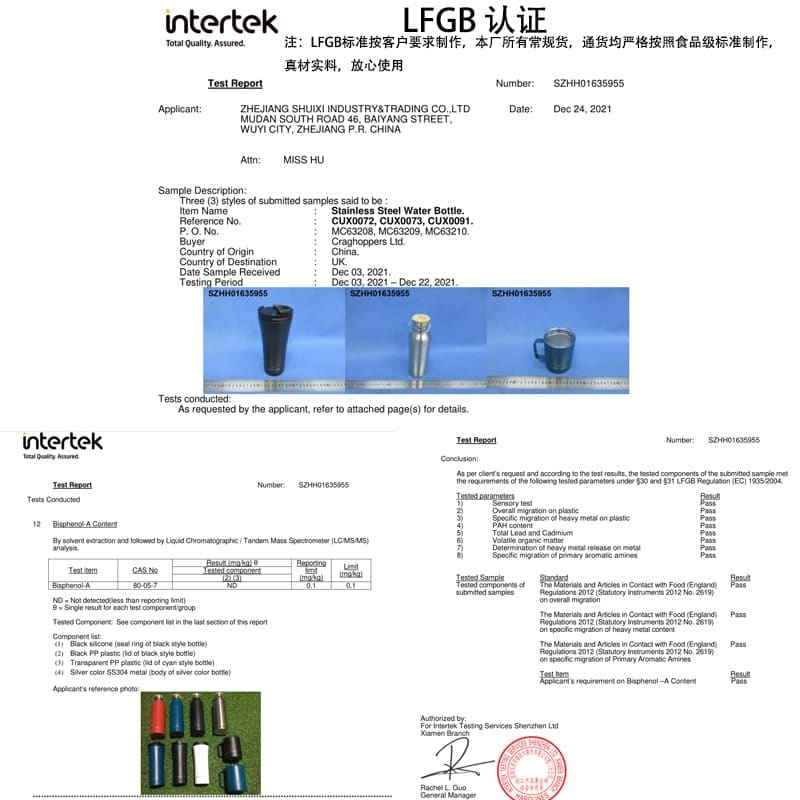
A useful file contains more than a first-page result. Ask for:
- final report with all pages and annexes;
- applicant, manufacturer and sample identification;
- product photographs and model information;
- components and materials tested;
- applicable requirement and method edition;
- sample receipt and test dates;
- results, units, limits and reporting limits;
- conclusion and limitations;
- laboratory identity and relevant accreditation information when required;
- supporting material declarations and traceability;
- a change-control record linking the tested sample to production.
A logo saying “BPA Free” is marketing artwork, not enough evidence by itself. Likewise, a supplier declaration may be useful but should be read for its scope, responsible party, materials, date and supporting basis.
Set Reassessment Triggers
Review the evidence when there is a change to:
- resin, elastomer, coating, ink, adhesive or colorant;
- material manufacturer or grade;
- lid, straw, gasket or contact geometry;
- intended beverage, temperature, duration or cleaning;
- product category or age grading;
- destination market or buyer protocol;
- applicable law, transition date or test method.
A change does not always require the same response. The result may be a documentation update, technical assessment or new test. The decision should be written and attributable.
Watersy’s Project-Specific Position
Watersy manufactures stainless-steel drinkware and supports PP, Tritan and silicone lid-related components. BPA-Free testing, FDA-related documentation, PFAS or phthalates requirements can be discussed according to the product construction, destination market and RFQ. They are not represented as one current, catalog-wide company certification.
The correct workflow is to stabilize the SKU, identify every relevant component, review available evidence, and then coordinate any additional testing required for that project. Use the food-contact test-scope guide to define the wider market and use conditions, and the certificate verification guide to check the resulting document.
RFQ Checklist
Include the following in your request:
- destination country or region;
- exact product and model;
- intended adult, child or other user category;
- complete component and material list;
- supplier, grade and color information where relevant;
- food-contact and mouth-contact map;
- temperature, duration, repeated use and cleaning conditions;
- required BPA, PFAS and phthalates scope;
- named legal, retailer or buyer protocol;
- method, reporting limit and acceptance criteria;
- production-representative sample plan;
- document language and delivery milestone;
- change-control responsibility.
A precise request prevents both over-testing and false confidence. It also gives suppliers and laboratories a common basis for quotation, sampling and approval.
Request Project-Specific Compliance Documents
Send Watersy the product configuration, target market, intended use and required chemical scope. The team can identify available evidence and coordinate discussion of additional product-specific documentation or testing.
Request Project-Specific Compliance Documents
Sources and further reading
Related guides